





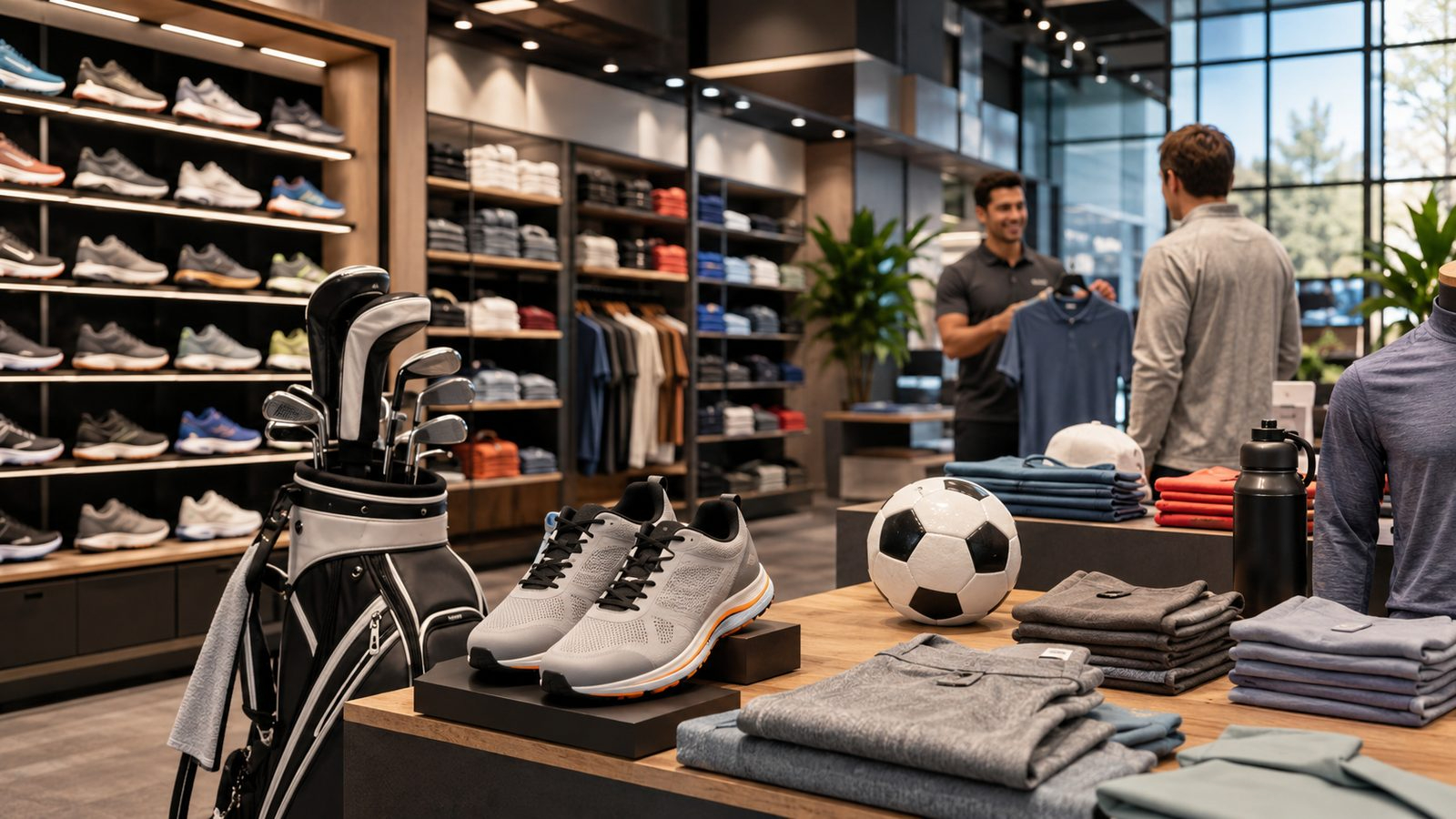
Why sporting goods is different from ordinary retail
A general or ecommerce-first POS is built for a simple catalog. Sporting goods breaks that model in a few ways at once:
- Huge range of price and size. A single store might sell a $1,500 set of golf clubs, a $3 pack of socks, running shoes in dozens of size/width combinations, and team jerseys in a full size run — all needing different handling.
- Matrix products. Footwear and apparel only make sense in a size/color/width grid; you need to buy, receive, and read stock across that grid, not as a flat list.
- Multi-store & seasonal. Demand shifts by season and location, so stock has to move to where it will sell — with pre-season buying and in-season replenishment.
- Online + in-store. Inventory has to stay accurate across the sales floor and the website in near real time.
What to look for in a sporting goods POS
- True matrix inventory for footwear (size/width) and apparel (size/color), used everywhere from purchase orders to receiving to reporting.
- Real-time multi-store inventory so every location and the website share one accurate stock picture.
- Rule-based distribution & replenishment — allocate a new buy across stores by sell-through, min/max, or days of supply, and rebalance stock between locations. (You set the rules; the system builds the distribution for your team to review and commit.)
- Depth for the full catalog — high-ticket items handled right next to fast-moving small accessories.
- Kits & bundles — group items and sell them as a single product (a starter package, a full uniform, or a set of clubs) while still tracking each component in stock.
- Reporting that’s readable — know your best and worst sellers by store, category, and season without living in a spreadsheet.
- Customer marketing, gift cards & loyalty — a deep CRM/marketing connection (like a real Klaviyo integration) and omnichannel gift cards + loyalty that work the same in-store and online.
- Flexible payments — card-on-file and pay-over-time (BNPL) options to serve VIPs and higher-ticket purchases.
- Ecommerce sync + support — a reliable connection to your online store, and responsive help when a register goes down mid-Saturday.
How the options compare
| What matters | Runit RealTime Cloud | General / ecommerce-first POS |
|---|---|---|
| Built for | Specialty retail incl. sporting goods, apparel & footwear | General merchandise / online-first sellers |
| Matrix inventory (size/color/width) | Yes — sized matrices with unlimited extensions | Flat variant lists; limited or no true grid |
| Rule-based multi-store distribution | 7+ allocation methods + stock balancing; you review & commit | Manual transfers; little automated allocation |
| Real-time multi-store inventory | Yes, across stores + warehouse | Varies; sync gaps common |
| Kits / bundles sold as one item | Group components into a kit and sell as a single product | Limited; sold as separate line items |
| Ecommerce | Integrates with Shopify, BigCommerce, Salesforce Commerce Cloud & WooCommerce | Often native (their strength) |
| Support | 24x7x365 US-based phone support | Varies by plan |
Other specialty systems compete here too — e.g. RICS is well known in run-specialty and footwear, and Lightspeed is common in sporting-goods shops. See our Runit vs Lightspeed and Runit vs RICS vs Teamwork pages for detail.
By sport: what matters most
Every sport has its own inventory quirks. Where Runit has deep experience:
Running & run specialty
Deep size/width matrices, fast model turnover, and gait-driven fittings. See Best POS for running stores.
Golf
High-ticket clubs and tech alongside apparel, gloves, and accessories; pro-shop and multi-location needs. See Best POS for golf shops.
Soccer
Footwear size/width, team kit, and seasonal club orders across multiple stores. See Best POS for soccer stores.
Spirit wear & college apparel
Licensed collegiate apparel and accessories sold by school and brand to students, alumni and fans, with big game-day and seasonal swings. See Best POS for spirit wear & college apparel.
Built for loyal, community-based customers
Sporting goods retail runs on regulars — the running club, the golf league, the families outfitting a team season after season. Two Runit strengths matter especially here:
Advanced Klaviyo integration (rare in this category)
Runit’s advanced, purchase-driven Klaviyo integration — uncommon among specialty-retail POS systems — syncs real buying behavior so you can target communication and promotions to the customers who matter most: your VIPs, a specific team or club, or everyone who bought a particular brand. It turns a loyal community into repeat revenue instead of a list you can’t segment.
Flexible, customer-friendly payments
Runit offers secure card-on-file (via Worldpay’s OmniToken, so card data is never stored in Runit or on your network) — ideal for VIPs and for taking secure payment when a customer orders from home. And built-in Buy Now, Pay Later lets shoppers spread the cost of higher-ticket items like a set of golf clubs over time, so price isn’t the reason a sale walks away.
Omnichannel gift cards & loyalty (with 99minds)
Through Runit’s partnership with 99minds, gift cards, loyalty, and promotions work as one system across your stores and your website — not the split setups that trip up so many retailers (a gift card that only works online, a loyalty program that ignores in-store sales, or the reverse). You get physical and digital gift cards redeemable in-store and online, a loyalty program that spans both channels, and automatic promotional gift-card programs you can trigger by a wide range of criteria and date ranges. Popular examples we see: rewarding total spend over a defined period once a customer hits set tiers, or “spend $X today (or buy this today) and get a $Y gift card” offers — so a seasonal push or loyalty tier runs itself.
Where Runit fits
Runit RealTime is a cloud retail platform built for specialty retailers who’ve outgrown entry-level tools but don’t want enterprise complexity. For sporting goods that means matrix inventory for footwear and apparel, rule-based distribution and stock balancing to move seasonal stock to the right stores, real-time visibility across every location and your website, readable reporting, and 24/7 US-based support. It’s a common landing spot for growing sporting-goods chains switching off general POS systems or legacy desktop software. See how Runit moves inventory across stores.
See Runit for your sporting goods stores
Book a demo and we’ll run matrix inventory, multi-store distribution, and reporting against your own product mix and store setup.
Frequently asked questions
What’s the best POS for a sporting goods store?
Do I need matrix inventory for a sporting goods store?
Can one POS handle high-ticket gear and small accessories?
Can a sporting goods POS bundle items and sell them as a kit?
How does a multi-store sporting goods chain keep inventory accurate?
How can a sporting goods store keep loyal customers coming back?
Do Runit’s gift cards and loyalty work both in-store and online?
Related