


Remote Support

little-phone

(888) 777-8648

Runit + Klaviyo: Turn POS Data Into Marketing That Performs

request a demo
New Call-to-action
The Runit + Klaviyo integration automatically syncs your customer profiles and real in-store purchase history into Klaviyo — so your segments, flows, and campaigns run on what customers actually buy in your stores, not just email signups. It’s a fully managed, hands-off sync: profiles stay current, in-store receipts become trackable events, and every field maps to how your brand markets.

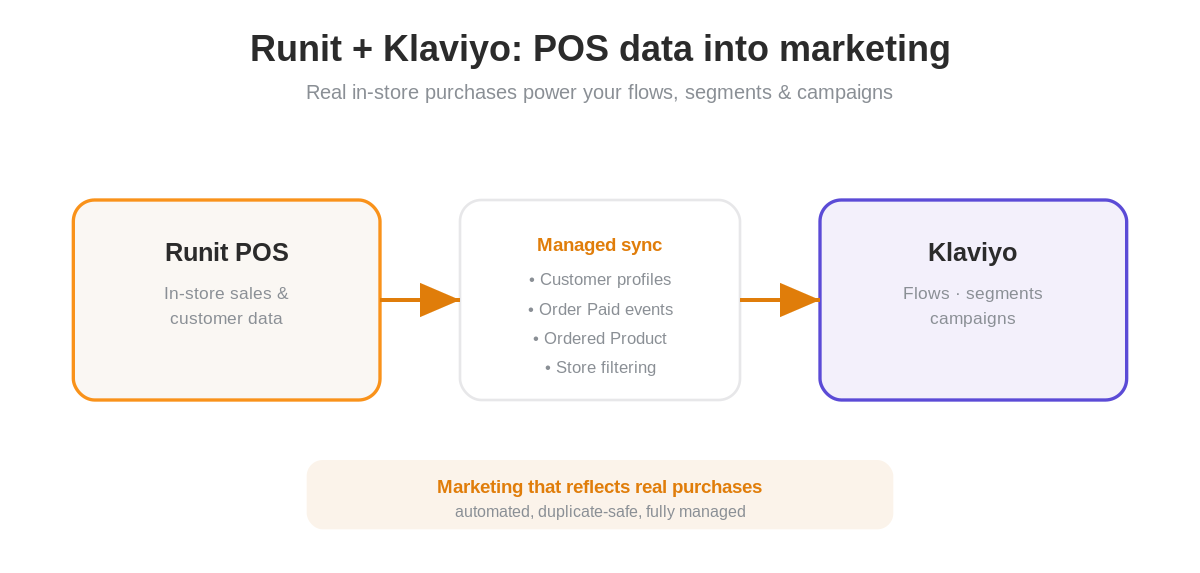
Runit in-store purchase data flowing into Klaviyo

What the integration does

Automated customer sync

Customer profiles sync from Runit to Klaviyo on an automated schedule that runs throughout the day, so your lists and segments always reflect the latest information.

In-store purchase events NEW

Real receipts flow into Klaviyo as Order Paid and Ordered Product events — unlocking post-purchase flows, product-based segmentation, and revenue reporting from your brick-and-mortar sales.

Multi-store & multi-brand control

Choose exactly which stores feed each Klaviyo account. Store-level filtering applies to both profiles and receipts, keeping multi-brand and multi-location data cleanly separated.

Discrepancy detection & auto-correction

The system compares Runit and Klaviyo, then creates missing profiles and updates changed fields automatically — keeping both aligned with no manual cleanup.

Enriched, custom-mapped profiles

Map any Runit field to Klaviyo — birthdays and special dates, lifetime and year-to-date sales, loyalty balances, preferences, and sizes — tailored per brand.

Flexible data sources

Pull data live from the Runit API, run targeted SQL queries, or import via CSV and SFTP — whatever fits your environment, through one unified engine.

What flows into Klaviyo

Customer profile fields

  • Contact & address — name, email, phone, location
  • Key dates — birthday, anniversary, first & last purchase
  • Sales history — lifetime, this-year & last-year totals
  • Loyalty — buying club, balances, earned & used
  • Preferences & sizes — personal categories and interests
  • Custom attributes — salesperson, discount %, and more

Purchase events

  • Order Paid — In Store: order-level event with subtotal, discounts, tax & total
  • Ordered Product — In Store: a line-level event for each item
  • Revenue value attached to every order for reporting
  • Duplicate-safe — each event is uniquely keyed so nothing double-counts
  • Store-filtered — only receipts from configured stores are sent

Why it matters

  • Marketing that reflects reality: segment and trigger flows on actual in-store purchases and products, not just email signups.
  • Accurate, trustworthy data: automatic comparison and correction keep profiles clean and reduce manual entry.
  • Hands-off & reliable: a fully managed, scheduled sync frees your team to focus on campaigns, not data plumbing.
  • Higher engagement: richer profiles and purchase signals power more personalized, higher-converting messaging.

How it works

Sign-up & configuration. Complete the Klaviyo Integration Request Form; we load your field mappings, store filters, and list preferences.
Data retrieval. The integration pulls customer records and receipts from Runit via API.
Comparison & validation. Runit data is compared against existing Klaviyo profiles to identify what’s new, changed, or already in sync — before anything is written.
Profile & event creation. New profiles are created, existing ones updated, and in-store purchases pushed as events; profiles can be added to your chosen list.
Ongoing automation. The sync runs on a set schedule with overlapping lookback windows so nothing is missed.
Testing & review. We test end-to-end and review results with your team; pre-write previews show exactly what will be created or updated.

Put your in-store sales to work in Klaviyo

See how Runit syncs profiles and real purchase events into Klaviyo — configured for your stores and brands.

Book a Demo

Already a Runit client? Request your Klaviyo integration setup →

Frequently asked questions

Does Runit integrate with Klaviyo?
Yes. Runit’s managed integration automatically syncs customer profiles and in-store purchase events from your Runit POS into Klaviyo, so your marketing lists, segments, and flows reflect real store purchases and enriched customer data.
Does the integration send in-store purchases to Klaviyo, not just online?
Yes. In-store receipts flow into Klaviyo as Order Paid — In Store and Ordered Product — In Store events, each with revenue values, so you can build post-purchase flows, product-based segments, and revenue reporting from brick-and-mortar sales.
Can I control which stores or brands sync to which Klaviyo account?
Yes. Store-level filtering applies to both profiles and receipts, so multi-brand and multi-location retailers can precisely target which stores feed each Klaviyo account and keep data cleanly separated.
What customer data can be mapped into Klaviyo?
Any Runit field can be mapped — contact and address, birthdays and anniversaries, lifetime and year-to-date sales, loyalty balances, preferences and sizes, and custom attributes like salesperson or discount percentage — tailored per client.
Is the sync automatic, or does my team have to run it?
It’s fully managed and automatic. After configuration and testing, the sync runs on a set schedule with overlapping lookback windows and duplicate-safe events, so new sales and profile changes are captured without manual work.
How do we get started?
Submit the Klaviyo Integration Request Form, and Runit configures your mappings, store filters, and lists, then tests and reviews the results with your team before go-live.